


The Epicor Prophet 21 end of life question has a dated answer. On-premises P21 gets its final release, 2028.1, tentatively in May 2028. Active Support runs through June 30, 2029, and Sustaining Support begins July 1, 2029. Epicor has published no date when on-premises P21 stops running, and says new functionality after 2028.1 goes to Epicor Cloud only.
From Crestwood Associates, an award-winning Microsoft partner and Acumatica Partner of the Year, trusted by clients like Summit Brands, Green Bay Packaging and Crown Metal.
On-premises P21 keeps running after 2029, but it stops changing after 2028.1. That leaves every on-premises distributor with one decision: move to Epicor Cloud, or move to a different ERP. The lead time a migration needs decides which of those options is still open by mid-2029.
The dates are published. Whether P21 is actually your bottleneck is still an open question, and it is the one worth answering first.
What Epicor Announced on January 6, 2026
On January 6, 2026, Epicor announced the schedule of its final on-premises releases for Kinetic, Prophet 21 and BisTrack. Existing on-premises systems keep running, and Epicor says on-premises customers will continue to receive support. What changes is the roadmap. Epicor says these releases mark the transition of future innovation for the three platforms “exclusively to the Epicor Cloud.”
Kinetic and BisTrack carry their own dates in the same announcement. If you are reading coverage of the news, check that the dates you are planning around are the Prophet 21 lines.
The Prophet 21 on-premises timeline
| Date | Milestone, in Epicor’s wording | What it means for an on-premises P21 system |
|---|---|---|
| January 6, 2026 | Schedule of final on-premises feature releases announced | The planning window opens. Nothing changes in the software yet. |
| May 2028, tentative | “Final on-premises release: 2028.1 tentatively scheduled May 2028” | The last on-premises release with new functionality. Epicor calls the date tentative, so it can move. |
| Through June 30, 2029 | “Active Support for release 2028.1 through June 30, 2029” | Active Support continues on release 2028.1. If you will still be on an earlier release, ask Epicor which dates apply to it. |
| From July 1, 2029 | “Sustaining Support begins July 1, 2029” | Sustaining Support. The announcement does not list what it covers. Ask Epicor in writing whether it includes security patches and tax updates. |
| No date published | No end date stated for on-premises use | The system keeps running. It stops gaining features. |
Source: Epicor, “Epicor Announces Schedule of Final On-Premises Feature Releases for Kinetic, Prophet 21, and BisTrack,” January 6, 2026. Quoted lines are Epicor’s wording. Accessed November 2, 2026.
Who the Prophet 21 Schedule Applies To
The schedule applies to on-premises Prophet 21. If your P21 runs anywhere other than Epicor Cloud, including a private data center or your own Azure or AWS tenant, confirm with Epicor which schedule applies to you, and get the answer in writing. The announcement does not address customer-managed cloud tenants, and a hosted server is still a system you patch and upgrade yourself.
For Epicor Cloud customers, Epicor says that concentrating development on the cloud gives them faster access to new features, including AI capabilities.
What Sustaining Support Covers, and What Epicor Has Not Said
Epicor’s announcement says customers move through Active Support and then Sustaining Support “to ensure ongoing security and operational continuity.” It does not itemize what either phase includes. Epicor’s Innovation Pathway page points to a Support Lifecycle Policy, and that policy sits behind an EpicWeb customer login, so the public record stops at the dates.
Trade press has filled part of the gap. Enterprise Times reported on January 9, 2026 that Sustaining Support provides access to the online knowledge base and limited telephone assistance, and that it does not include new features, full bug-fix coverage or the sale of new modules. That is a reporter’s summary, not Epicor’s policy text. Treat it as a reason to ask, not as the answer.
Four questions to put to Epicor in writing before you plan around July 2029:
- Does Sustaining Support for release 2028.1 include security patches, and until when?
- Do tax and regulatory updates keep shipping for on-premises 2028.1 after July 1, 2029?
- Which schedule applies to our deployment: on-premises, our own Azure or AWS tenant, or an Epicor-hosted environment?
- If we are on a release earlier than 2028.1 in 2029, what support do we have?
What Changes for an On-Premises P21 Distributor
No new functionality reaches on-premises P21 after 2028.1. The system stops changing while customers, carriers, tax rules and trading partners keep moving. The order, inventory and warehouse processes you run on P21 in 2029 are the ones you keep running for as long as you stay. How much that matters depends on the answers to the four questions above.
- Security. If Sustaining Support does not include security patches, every vulnerability found after July 2029 stays open. Get the answer in writing before you plan around it.
- Tax and regulatory change. Tax and regulatory changes may stop reaching the software, depending on what Sustaining Support covers.
- Add-ons and integrations. EDI connectors, warehouse add-ons and reporting tools are built against releases their vendors still test. Ask each vendor how long it will support P21 2028.1.
- Workarounds. Every spreadsheet that sits between P21 and the warehouse today will still be there in 2030, because nothing new is coming to replace it.
Your Three Options Before June 30, 2029
An on-premises P21 distributor has three paths before Active Support ends, and each one is the right call for some businesses. The table sets them side by side on the same five rows. Below it, each path gets the same short case for when it wins.
| Stay on-premises on Sustaining Support | Move P21 to Epicor Cloud | Re-platform to a different cloud ERP | |
|---|---|---|---|
| What changes | Nothing in the system. Support moves to Sustaining from July 1, 2029. | Where P21 runs and who runs the infrastructure. | The platform, the processes on it and the partner behind it. |
| New functionality after 2028.1 | None. | Yes. Epicor says future innovation goes to Epicor Cloud only. | Yes, on the new platform’s release schedule. |
| Project size | Smallest today. Grows each year the system stays frozen. | A migration, on Epicor’s program, Ascend with Epicor. | The largest of the three. Needs the most lead time. |
| Main risk | Sustaining Support scope is not public. | Today’s workarounds move to the cloud with you. | Starting too late to finish before Active Support ends. |
| Fits when | P21 runs the business well and you need time to decide. | The pain is where P21 runs: servers, upgrades, IT load. | The pain is how the work runs: rekeying, spreadsheets, disconnected warehouse or EDI. |
When staying on-premises is the right call
Your P21 workflows fit the business, your team is not working around the system, and you have Epicor’s written support terms for 2029 onward. Staying buys time to decide well. It only works if the decision is still made, with a date on it.
When Epicor Cloud is the right call
Your P21 workflows fit the business and the cost sits in the servers, the upgrade cycles and the IT hours. Moving to Epicor Cloud fixes where P21 runs, keeps the system your team already knows, and puts you back on Epicor’s release path.
When re-platforming is the right call
Your team keys the same order twice, closes the month in spreadsheets, or runs warehouse and EDI work outside the system. Moving P21 to the cloud fixes where it runs, not how it runs. If the pain is the workflow, the 2029 date is the cheapest point to change platforms, because a migration is coming either way.
How Much Lead Time a Prophet 21 Migration Needs
In Crestwood’s experience, mid-market distributor migrations run 12 to 18 months from decision to go-live. Count back from June 30, 2029. An 18-month project has to start by January 2028, before Epicor’s final release ships. A 12-month project has to start by the end of June 2028.
That puts the latest start date for a re-platform inside the same months as release 2028.1. Waiting to see what 2028.1 contains spends the window the decision needs.
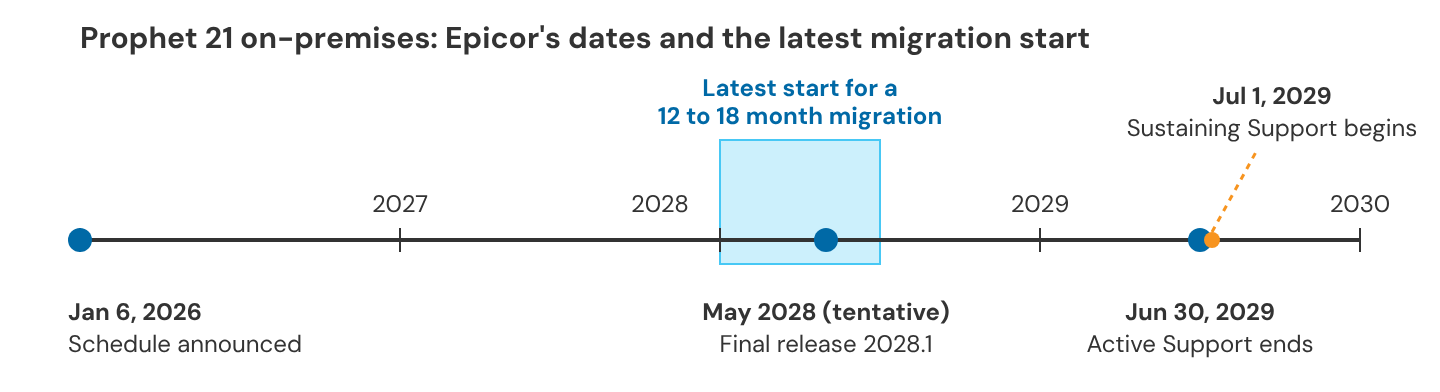
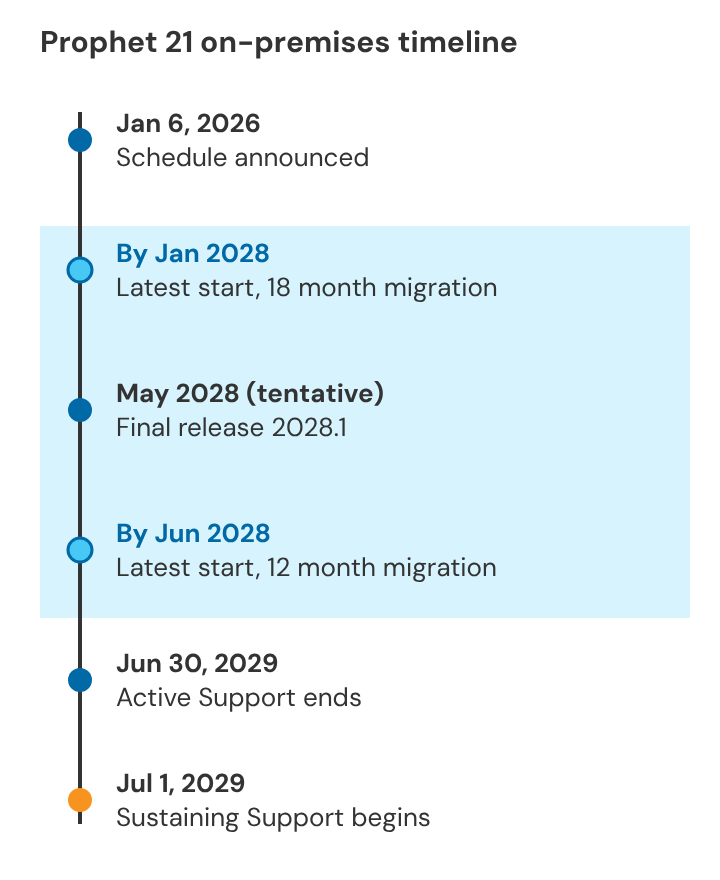
Epicor dates from Epicor’s announcement of January 6, 2026. The shaded start window assumes a 12 to 18 month migration, which is Crestwood’s experience rather than an Epicor figure.
A re-platform decision is also a partner decision. Crestwood evaluates any ERP choice on three legs at once, Partner, Platform and People, which we call the Three-Legged Stool. A strong platform with the wrong partner, or a team that never adopts it, fails the same way a weak platform does. Our guide on how to evaluate an ERP platform before you commit covers the platform leg, and the ERP partner selection checklist covers the partner leg.
Where Crestwood Fits
Crestwood implements Acumatica and Microsoft Dynamics 365 Business Central for distributors and manufacturers. We have a stake in the re-platform option, so weigh our view with that in mind. If your workflows fit P21 and Epicor Cloud is the better path, we will tell you.
When the problem is how the work runs, the gains show up in the operation. Summit Brands in Fort Wayne, Indiana, eliminated more than 100 hours a month of manual EDI and AR work and onboarded 120 trading partners in under 10 months. That project was not a Prophet 21 migration. It shows what changes when EDI stops running through people.
If you want to see a modern cloud ERP before talking to anyone, walk through the self-guided Business Central tour.
Crestwood is an award-winning Microsoft partner and Acumatica Partner of the Year, in business since 1998.
The first step is a Business Optimization Assessment. The session looks at how orders, inventory and the month-end close run today, where the workarounds sit, and whether the system is the cause. You leave knowing whether P21 is your bottleneck and which of the three paths fits your business.
The business may not have a people problem. It may have an operating model problem.
We sell, implement, support, and optimize it. An in-house team of industry experts. One hand to shake.
Trusted by clients like Wet & Forget, which cut its month-end close from eight days to five after moving from Dynamics GP to Business Central with Crestwood.
Book your assessment with an industry expert for your business, and leave knowing which Prophet 21 path fits your timeline.
Epicor Prophet 21 End of Life: Frequently Asked Questions
Is Epicor Prophet 21 end of life?
Epicor has not announced an end-of-life date for on-premises Prophet 21. It has announced the final on-premises release, 2028.1, tentatively scheduled for May 2028. Active Support for that release runs through June 30, 2029, and Sustaining Support begins July 1, 2029. After 2028.1, Epicor says future innovation moves exclusively to the Epicor Cloud.
When is the last on-premises release of Prophet 21?
Release 2028.1, which Epicor says is tentatively scheduled for May 2028. Epicor uses the word tentatively, so treat May 2028 as a planning date rather than a fixed one.
When does Prophet 21 Active Support end?
Epicor states that Active Support for release 2028.1 runs through June 30, 2029, and that Sustaining Support begins July 1, 2029. If you will still be on an earlier release in 2029, ask Epicor which dates apply to it.
What happens to on-premises Prophet 21 after June 30, 2029?
The system keeps running on Sustaining Support. Epicor’s announcement does not define what that covers, so ask Epicor in writing whether security patches and tax updates continue.
Does Prophet 21 Sustaining Support include security patches?
Epicor has not said so publicly. Its announcement describes the support phases as ensuring ongoing security and operational continuity but does not itemize them, and its Support Lifecycle Policy sits behind a customer login. Enterprise Times reported on January 9, 2026 that Sustaining Support excludes full bug-fix coverage. Get Epicor’s answer in writing.
Does the schedule apply if Prophet 21 runs in Azure or AWS?
Epicor’s schedule covers on-premises Prophet 21, and its announcement does not address customer-managed cloud tenants. If your P21 runs in your own Azure or AWS tenant, or anywhere other than Epicor Cloud, confirm with Epicor which schedule applies before you plan around it.
Is Prophet 21 in Epicor Cloud affected?
Epicor says future innovation for Prophet 21 moves exclusively to the Epicor Cloud and that cloud customers get faster access to new features. The on-premises release schedule describes no change for Epicor Cloud customers.


